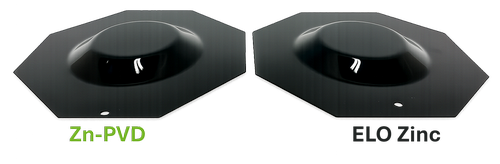
Zn-PVD coatings can be processed in the same way as conventionally coated steel strips. They can be used for all applications up to the most demanding automotive applications.
ThePlasma-Enhanced Evaporation Technology (PEPVD) developed by NEOVAC is a virtually cold and hydrogen-free coating process that allows for precise control over the coating. Coating properties can be systematically optimized.
Even the material properties of AHSS are not affected by coating using Plasma-Enhanced Vapor Deposition (PEPVD) technology. In one test, martensitic steel (MS 1500) was coated with Zn-PVD. The Zn-PVD coating has no effect whatsoever on the material properties of MS 1500, since the temperature of the base material never rises above 200 °C during the process. Nevertheless, the ion plasma between the nozzle and the substrate enables coating properties that would otherwise require significantly higher temperatures.
Corrosion protection
Zn-PVD coatings provide corrosion protection on par with that of conventional coating methods. For the same coating thickness, the method used to apply the zinc has no bearing on corrosion protection. However, Zn-PVD coatings have an extremely dense and fine-grained structure.
Surface finish
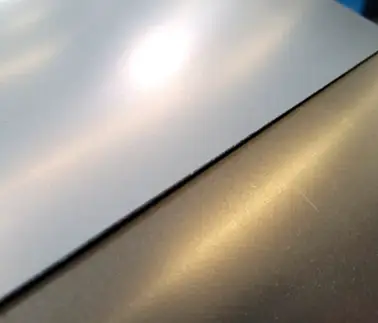
Zn-PVD coatings have a satin-matte, extremely uniform surface similar to that of electrolytic zinc plating. No macro-crystals or ripples, as seen in hot-dip galvanizing, are visible. Zn-PVD coatings replicate the surface texture of the base material.
Layer adhesion/formability
Zn-PVD coatings deposited using plasma-enhanced vapor deposition (PEPVD) exhibit excellent adhesion on all surfaces. Regardless of whether they are deposited on DC01 or martensitic steel (e.g., MS 1500), the coatings consistently demonstrate excellent adhesion.
The ion plasma generated by the PEPVD process between the nozzle and the substrate produces coatings with extremely high adhesion. Even when subjected to destructive testing methods such as the ball-impact test, no signs of delamination are visible, even under a microscope.
Thanks to its excellent layer-to-layer adhesion, it also offers excellent formability.
Morphology
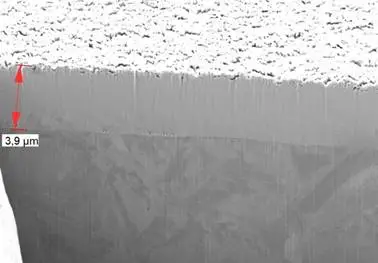
Zn-PVD coatings have an extremely dense and homogeneous structure. Using the plasma-enhanced evaporation technology developed by NEOVAC, it is possible to produce an exceptionally fine-crystalline morphology even in thick coatings.
Zn-PVD coatings do not form their own structures; therefore, they replicate the surface of the base material.
Ra=0.7μm RPc=55/cm Wsa=0.22μm
After Zn-PVD coating (15 µm):
Ra=0.7μm RPc=55/cm Wsa=0.24μm
Paintability
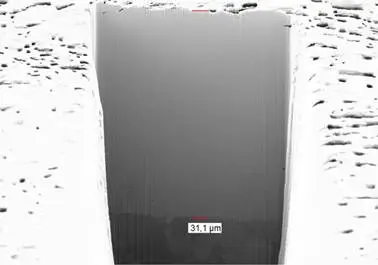
Zn-PVD coatings have paintability comparable to that of conventional coating methods. This can even be improved through the use of appropriate post-treatment coatings.